
I have worked with performance, both as a creator, pedagog and artist in others’ works.
performance becoming with the world *
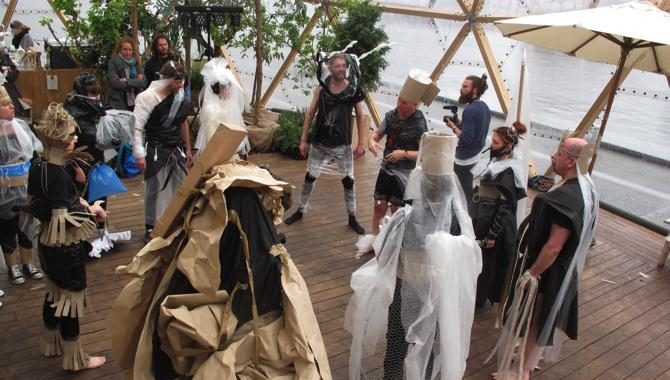
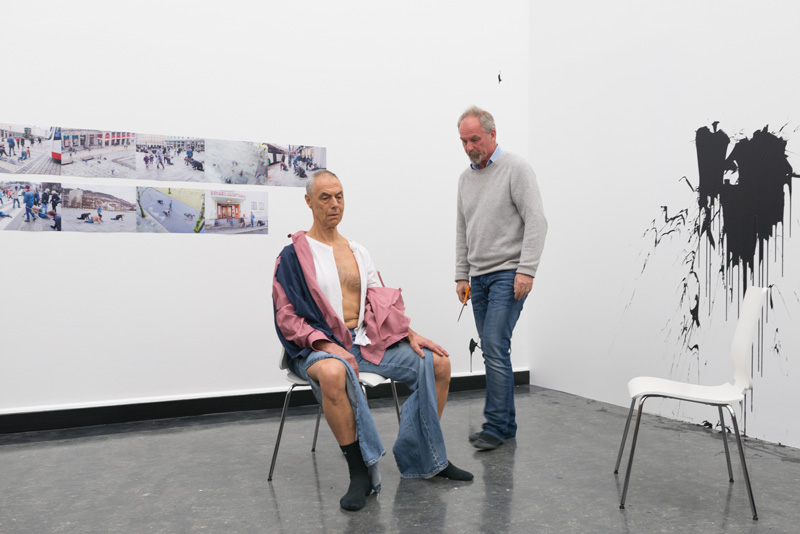
“Mysterious Gift from the Sky” 2015 Produced together with Hans Peter Tommila.
Live improvised noise music by CAM.
Film: De Nye Vokse (Jonas Bræmer-Jensen and Simon Anker-Larsen).
Performance
When I myself produced and taught performance, I have been looking for another concept that better describes my ideas about an alternative to theatre. I think I have found it in the notion of
Påhitt (Figment).
It seems that this concept better captures what I’m trying to do in my own work.
To me Påhitt is a completely open concept that nobody can own…
We all can
… recognize ourselves in the sentence “We’ll find something to do.” It is not possible to describe exactly what it means or should contain.However, it is possible, in retrospect and in relation to its context, to seek references amongst more established concepts.This is primarily done outside of the established theatre tradition that we see most on our stages. This means that in ‘Påhitt‘ we find traces of happening, performance, immersive theatre, post-dramatic theatre and other contemporary performing arts forms.
My understanding of scenography is linked to the relationship between
body – space – action
Scenography and costiumes for “Drömspelet” with Keve Hjelm – 1992
In my master thesis “A Scenographer’s reflections on his knowledge and motivations” from Södertörn University College, I develop my take on knowledge creation in the field of scenography. By trying to answer the question “What is scenography?“, I come to a conclusion that…
”Scenographer uses knowledge and skills from theoretical – scientific knowledge – Episteme, although it does not have a prominent role in the work.Another form is practical – productive knowledge – Techne. It has a predominant role when associated with the visible aesthetic result, which is the final proof of scenography. In my manifesto, however, I argue that the third form, practical wisdom – Fronesis, is the one that controls the two other in work with scenography. It is closely interwoven with a purpose and objectives of a performance and touches also ethics and morals.This last form leads set-design work by deciding when my efforts are to be taken, to what extent and through which means the work is carried out. Fronesis is knowledge that adds rhytm to my process.I have taken from Bengt Gustavsson and his division into three different forms of knowledge. His point of departure is Aristotle and what he writes in ‘The Nicomachean Ethics’.”
The whole essay is available for download >> here
A process manifests in time and space.
This is what I create spatially,
but also bodily
as a set designer,
regardless of context.
As a scenographer and costume designer, I have worked in different contexts, both through external assignments and my own projects. I have mainly worked with performing arts and exhibitions. I have a degree in Theatre Scenography from the Dramatic Institute in Stockholm and finished courses in Exhibition Design at Linköping University.
With own experiences as actor, among others from the Institutet for Scenkonst and Laban dance, I see myself as a scenographer with deep understanding of audience as well as those who occupy the stage.
My scenography is not architectural, rather “body close” and explores relationship between stage and audience.
Exhibition design for museum Kulturen in Lund “Märk väl” – 2009
” så fungerar världen för förklararna som fått allt förklarat för sig “
Jacques Ranciére.
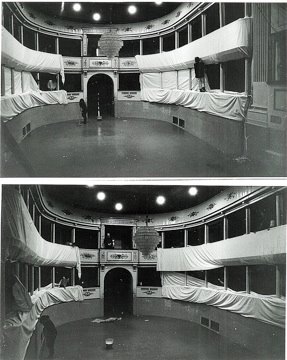
Devising, an English concept, is sometimes translated to Swedish as ‘Påhitt‘. In theatre contexts, devising is usually used in process theatre.
Devising has a strong focus on the group and its process. Working with devising, a great emphasis is put on that “everyone” in the group participates in the creation of content and form and hierarchy is as flat as possible.
“That is, to answer the initial question What is Art? :
art could (but might not) be simply doing art, whatever that is, as long as it can`t be identified.”
Allan Kaprow
Identifying what art is or can be – that I do not find especially important. Therefore, I see the above quote as a good answer to the question that in this way stays open, unanswered and alive. In the process of investigation, art and artists will produce new art, whatever it may be. That is the principle I intend to follow and contribute to.
The ‘Nordstedts svenska‘ dictionary describes ‘Påhitt‘ as “something new that a person has conceived with the help of imagination“.
Finding things is something we all have experience with – perhaps especially when we think back to our childhood. For me, the concept of ‘Påhitt‘ is an open concept that cannot be pinpointed, other than temporarily at the time of every single invention. And it is not possible to deny anyone access to inventing. In this way, Påhitt can be a point of departure for processes that search for the “new”. I write about it in my master thesis:
Serendipity in pedagogical work. The emancipated performing arts student: påhitt!
I came into contact with Fronesis as a concept while studying Praktisk Kunskap at Södertörn University. Fronesis or practical wisdom as Bernt Gustavsson translates it in his Kunskaps Filosofi Tre kunskapsformer i historisk belysning (Gustavsson 2000). Here I freely relate to the explanation given by Gustavsson, with reference to Aristotle. Fronesis (political-ethical) is one of the three concepts of knowledge, the other two being Episteme (theoretical-scientific) and Techne (practical-productive). Fronesis has a strong connection to wisdom. “The wisdom we can get an idea of says Aristotle, by investigating which people are wise. The characteristic of the wise is that this can consider things that are good and useful with regard to a good life at all. That ability is neither knowledge nor skill “(Gustavsson 2000 33-4). Fronesis describes the changing and complex relationship between where, when, how and to what extent an action takes place and in relation to who / what. Fronesis also points out that each new situation requires its own solution.
Letting the wisdom manifest in processes associated with performing arts or other artistic activities becomes important in an ethical way and reflection is necessary in order to come into contact with Fronesis. Through Fronesis and reflection we become aware of where, when, how, with whom and to what extent our work is executed. It also focuses on and draws attention to the fact that the work will need consider the ethical and moral dimension. There are several possible ways and answers to how a process and its result can best manifest. In other words, uncertainty and variation are value. Also as a means to rhythmize the process to create space for these variations.
I write more about the above in my essay “A scenograph’s reflections on her skills and driving forces”.
Pedagogy Art My pedagogical work takes character of open flow and processes with a strong connection to the whole, such as performing arts or other spatial cultural production.

These processes are inherently unpredictable and difficult to fully overview. It assumes more a form of constant discovery and exploration. This can feel confusing and “unfinished”.
Then it is important to dare to risk a failure, meant as “It was not as we had imagined.” In failure lies the opportunity to find new knowledge, but also to strengthen the already existing knowledge.
This we achieve together by being curious and daring to “meet”. In my work, I use techniques and methods that are inspired by play, Reggio Emilia pedagogy, devising, view points, drama and design theory.


Fine Arts and Photos
to answer the initial question:
what is art?
…art could (but might not) be simply doing art,
whatever that is, as long as it can`t be identified.
Allan Kaprow


måleri painting
flatbitning flat(binding)

I move between painting, graphics, photography, stop motion and installations.
Some examples of these techniques are shown below.

monotypi monotype
torrnål dry point

OO,,,
*…”:*


